Skip to content
Raisalon

Machine learning · Generative AI

Salon Rai builds ML and GenAI systems that ship.

Computer vision, forecasting, and LLM applications, trained, evaluated, and deployed behind real APIs.

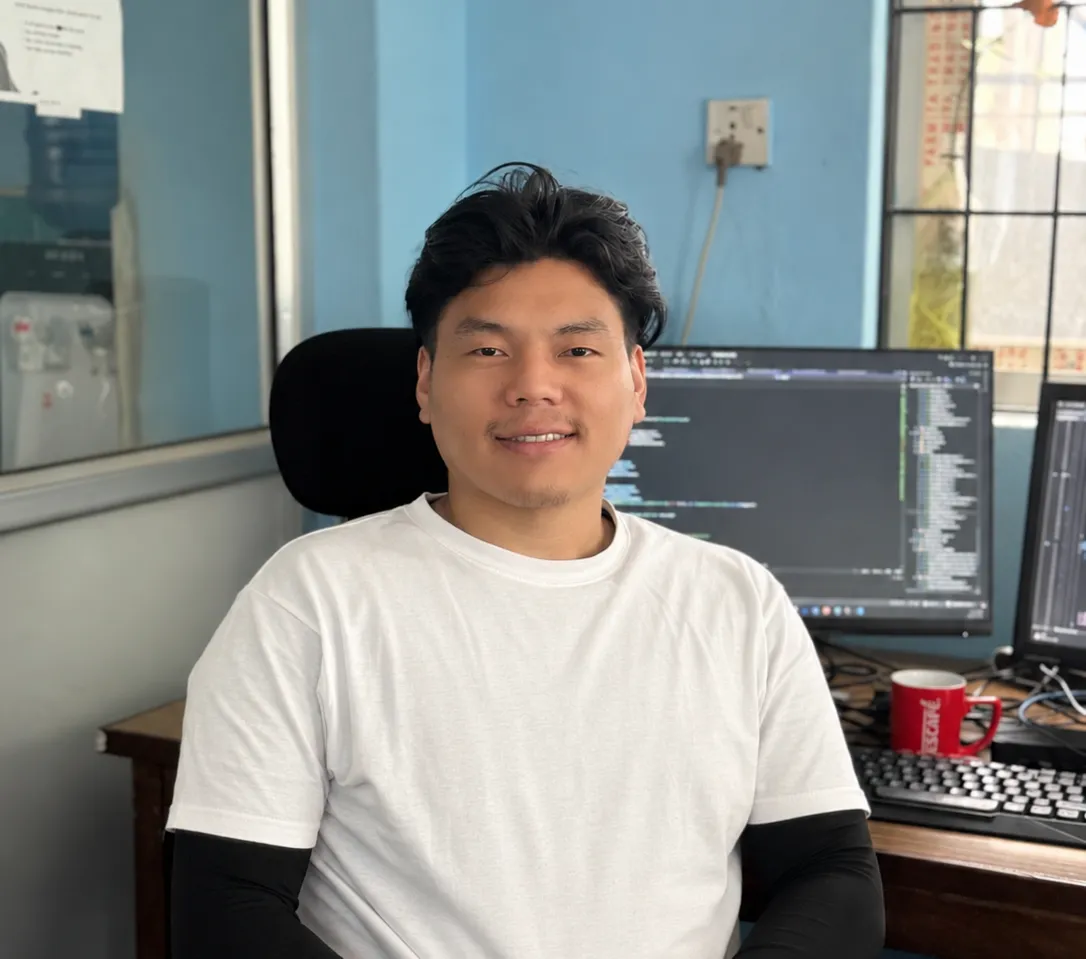
Salon Rai at a desk with code on the monitors behind
  • Computer visionCNNs · OpenCV
  • LLM apps & RAGEmbeddings · Ollama
  • Model to productionFastAPI · React

Expertise

What I work on

From classical models to LLM applications, with the engineering to put them in production.

  • Machine learning

    Supervised models on structured data, with leakage-free splits and evaluation that goes beyond accuracy: precision–recall, F1 averaging, and ranking metrics.

    • scikit-learn
    • XGBoost
    • pandas
    Machine learning articles
  • Deep learning & computer vision

    CNNs for medical image classification, face embeddings for recognition, and LSTMs for time-series forecasting, each served behind an API.

    • PyTorch
    • TensorFlow
    • OpenCV
    Deep learning projects
  • Generative AI & LLMs

    LLM applications with retrieval: embedding search, measuring RAG retrieval quality, prompt regression tests in CI, and local models with Ollama.

    • LangChain
    • RAG
    • Vector databases
    Generative AI articles
  • ML engineering & deployment

    Turning models into products: Python APIs for inference, React front ends for the people who use them, and automated tests and deploys.

    • FastAPI
    • Docker
    • MLflow
    All projects

Selected work

Case studies

Problem, approach, the engineering decisions behind each one, and what shipped.

All projects

Deep learning

Face recognition attendance system

Solo project: computer vision pipeline, Django back end, and dashboard

  • Python
  • Django
  • OpenCV
  • face_recognition
  • dlib
  • NumPy
Problem
Manual roll calls are slow and easy to get wrong, and the records end up scattered across sheets.
Approach
dlib face detection with 128-dimensional face embeddings, compared by distance against enrolled students. No classifier to retrain when someone new enrolls.
Key decisions
  • Embedding distance instead of a trained classifier, so enrolling a student is one photo, not a retraining run.
  • Match tolerance tightened from the library default of 0.6 to 0.5: a missed match costs a retry, a false match marks the wrong student present.
Delivered
A Django app with photo enrollment, camera check-in, date and student filters, and CSV export.

Deep learning

Stock price prediction with LSTM

Solo project: data pipeline, LSTM inference, Flask API, and React dashboard

  • Python
  • TensorFlow
  • Keras
  • LSTM
  • Flask
  • scikit-learn
Problem
Measure how closely a sequence model can track next-day closing prices for any listed stock.
Approach
A Keras LSTM over 100-day sliding windows of scaled closing prices, served by a Flask API with a React dashboard for comparison charts.
Key decisions
  • Time-ordered 70/30 split with no shuffling, so the model is always tested on data after what it learned from.
  • The last 100 training days are prepended to the test set, so the first test prediction has a full input window.
Delivered
A Flask API and React dashboard charting predictions against actual closes, with 20- to 200-day moving averages and a dataset download.

Deep learning

Brain tumor detection from MRI scans

Solo project: CNN inference, Flask API, and React interface

  • Python
  • TensorFlow
  • Keras
  • CNN
  • Flask
  • NumPy
Problem
Classify a brain MRI as glioma, meningioma, pituitary tumor, or no tumor, outside of a notebook.
Approach
A Keras CNN on normalized 128 × 128 images, served by a Flask API that returns the predicted class with its softmax confidence.
Key decisions
  • Model served behind a separate Flask API, so the interface and the model can change independently.
  • Uploads resized to 128 × 128 and scaled to 0–1 in the API, so serving uses exactly the input format the model was trained on.
Delivered
A React upload interface with results in seconds, a health-check endpoint, and documented limits: not a diagnostic tool.

Roadmap

Currently building

Production-style projects in progress. Each page sets out the goal, the approach, and how it will be evaluated.

  • Generative AIPlanned

    Document Q&A with RAG and an evaluation suite

    A retrieval-augmented question-answering service over real PDF documents, with cited answers and an evaluation suite that runs in CI on every change.

    • Python
    • FastAPI
    • pgvector
    • Embeddings
    • LLM APIs
  • Traditional MLPlanned

    End-to-end demand forecasting with MLOps

    A demand forecasting model on messy public data, taken from raw files to a monitored prediction API with experiment tracking, CI, and drift detection.

    • Python
    • pandas
    • scikit-learn
    • LightGBM
    • MLflow
  • Generative AIPlanned

    Tool-using LLM agent with tracing and guardrails

    An LLM agent that completes real tasks by calling APIs and querying a database, with tracing, guardrails, and a task-success benchmark.

    • Python
    • LLM APIs
    • Tool calling
    • FastAPI
    • SQLite
  • Deep learningPlanned

    Fine-tuned vision model with ONNX deployment

    A modern image model fine-tuned on a real dataset, exported to ONNX for fast inference, and deployed as a public demo with documented accuracy and latency.

    • Python
    • PyTorch
    • YOLO
    • ONNX Runtime
    • Gradio

Approach

How I build ML systems

The practices behind every project, each one written up with working code.

  1. 01

    Frame the problem

    Start from the decision the model supports, then choose the metric that matches its cost: recall when misses are expensive, precision when false alarms are.

    Why 99% accuracy can mean zero recall
  2. 02

    Prepare data without leakage

    Check joins for duplicate keys and split by entity, so the test set holds customers or patients the model has never seen.

    Splitting a dataset by customer ID
  3. 03

    Train and evaluate honestly

    Compare against simple baselines and report metrics that hold up under class imbalance: average precision, PR AUC, and macro or weighted F1.

    Average precision vs. PR AUC
  4. 04

    Measure retrieval before prompts

    For LLM applications, evaluate the retriever with recall@k and MRR first, and estimate cost per request before launch.

    Evaluating RAG retrieval with recall@k and MRR
  5. 05

    Serve it behind an API

    Package models behind FastAPI or Flask endpoints with a front end people can use, so results reach users instead of staying in a notebook.

    Deployed deep learning projects
  6. 06

    Test like code

    Run regression tests on prompts and model outputs in CI, so a quality drop fails the build before it reaches production.

    Prompt regression tests in GitHub Actions

Toolkit

Skills & tech stack

Tools I use across the ML lifecycle, from data and training to serving and the product around it.

Programming & data

  • Python
  • SQL
  • TypeScript
  • pandas
  • NumPy
  • Matplotlib
  • Jupyter
  • Git
  • Linux

Machine learning

  • scikit-learn
  • XGBoost
  • LightGBM
  • Feature engineering
  • Time-series forecasting
  • Model evaluation

Deep learning & computer vision

  • PyTorch
  • TensorFlow
  • Keras
  • CNNs
  • LSTMs
  • Transformers
  • Hugging Face
  • OpenCV

Generative AI & LLMs

  • OpenAI API
  • Claude API
  • LangChain
  • LlamaIndex
  • RAG
  • Embeddings
  • Vector databases
  • Prompt engineering
  • Fine-tuning (LoRA)
  • Ollama

MLOps & LLMOps

  • Docker
  • MLflow
  • GitHub Actions
  • Promptfoo
  • Langfuse
  • Model monitoring

APIs & data stores

  • FastAPI
  • Flask
  • Django
  • REST APIs
  • PostgreSQL
  • pgvector
  • SQLite

Frontend for AI products

  • React
  • Next.js
  • Angular
  • Tailwind CSS

Background

From video editing to AI

Each step added a layer, from visual storytelling to the systems behind AI products.

  1. Step 1

    Video editing

    Where it started: storytelling, pacing, and attention to detail in every frame.

  2. Step 2

    WordPress development

    Building and customizing websites, and learning how the web works under the hood.

  3. Step 3

    Full-stack development

    Complete web applications, from React and Angular front ends to APIs and databases.

  4. Step 4Now

    AI & machine learning

    Machine learning, deep learning, and generative AI, from training the model to shipping it in a product.

Writing

Latest on AI & ML

All articles

Free tools

Browser tools

All tools
  • Developer

    JSON Formatter and Validator

    Format, minify, validate, and sort JSON in your browser, with error messages that point to the exact line and column of a syntax problem.

    Open tool

  • Developer

    Base64 Encoder and Decoder

    Encode text to Base64 or decode Base64 back to text, with full UTF-8 support and an optional URL-safe alphabet for tokens and URLs.

    Open tool

  • Developer

    Unix Timestamp Converter

    Convert Unix timestamps in seconds or milliseconds to readable UTC and local dates, and convert dates back to timestamps, with live current time.

    Open tool