
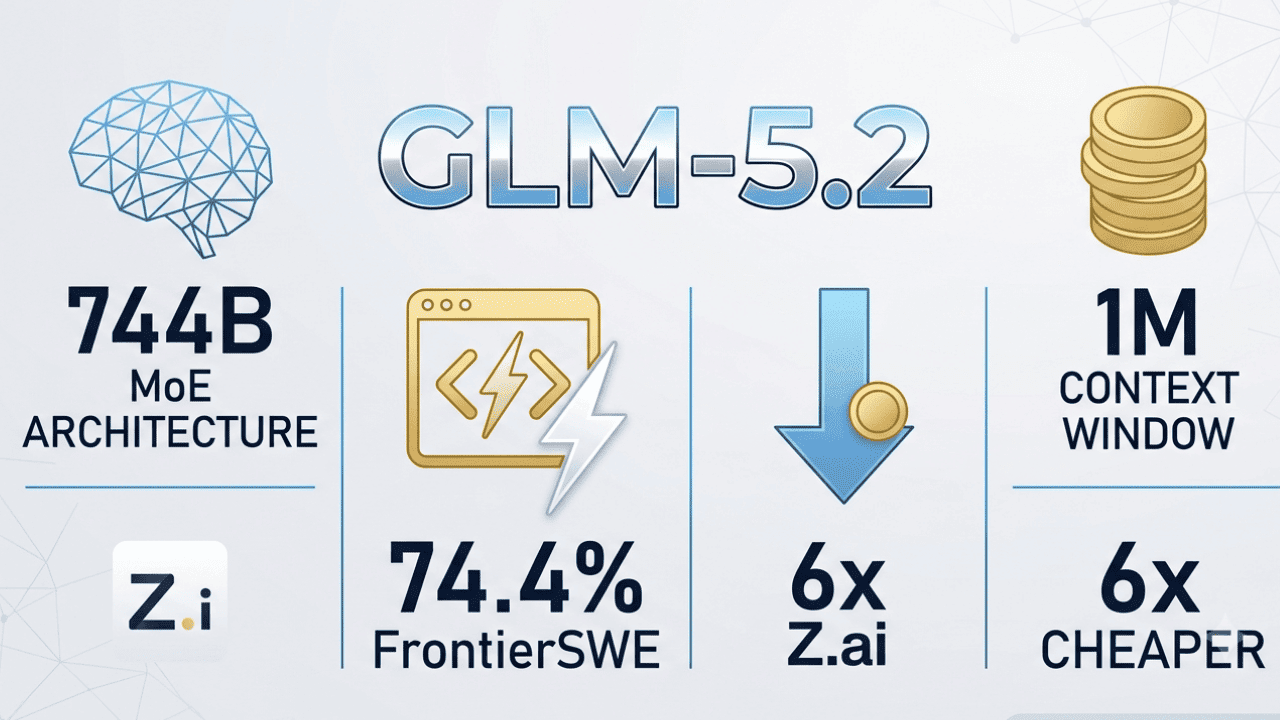
Let’s be completely honest for a second. Most AI models today have the attention span of a goldfish.
You can ask them to write a quick email or summarize a short webpage, and they do a great job. But what happens when you ask an AI to plan a six-month marketing strategy, write a piece of enterprise software, or conduct deep, multi-stage academic research?
They get lost. They forget your original instructions halfway through. Sometimes, they just start making things up to cover up the fact that they lost the thread.
That is exactly the problem the newest iterations of General Language Models are trying to solve. Enter GLM-5.2.
If you are tired of babysitting your AI tools, you need to understand what this model is doing differently. GLM-5.2 isn’t just another incremental update meant to make chatbots a little faster. It is specifically built for long-horizon tasks. But what does that actually mean, and why should you care?
The Problem with Short Attention Spans
To understand why GLM-5.2 is a big deal, we have to talk about how we currently use AI.
Most of what we do with standard chatbots falls under the category of short-horizon tasks. You ask for a recipe, a joke, or a blog post outline. The AI pulls from its training data, generates a response, and the interaction is over.
But real work isn’t like that. Real work is messy and complex. A long-horizon task is a multi-step objective that requires sustained reasoning over time. Imagine asking an AI to read a massive financial report, identify hidden market trends, draft a comprehensive strategy document based on those trends, review its own draft for logical inconsistencies, and format the final output for a corporate presentation.
To do this successfully, an AI can’t just have a good memory. It needs something closer to executive function. It needs to keep the ultimate goal in mind while executing dozens of micro-steps without losing the plot. Historically, large language models have failed spectacularly at this because of something called context decay. The further along a conversation gets, the more the AI’s intelligence degrades. It starts taking shortcuts and ignoring earlier instructions.
How GLM-5.2 Tackles Long-Horizon Reasoning
GLM-5.2 represents a fundamental shift in how these models are architected. Instead of focusing purely on being a snappy, conversational assistant, the developers decided to tackle the hardest problem in artificial intelligence: sustained, complex reasoning.
The model does this by making context highly usable. Having a massive context window—meaning the AI can ingest a lot of text at once—is like having a giant desk. But if your desk is completely covered in clutter, you still can’t find what you need. GLM-5.2 uses advanced attention mechanisms to actually retrieve and weigh the importance of information buried deep within massive datasets. It doesn’t just read a whole codebase; it remembers how the code at line ten affects the logic at line ten thousand.
Beyond just memory, GLM-5.2 is built with agentic workflows in mind. This means it doesn’t just sit there waiting for your next prompt like a glorified search engine. You can give it a high-level goal, and it will break that goal down into a web of sub-tasks. It can pause, evaluate its own progress, correct its own mistakes, and keep moving forward autonomously until the entire task is finished.
What This Means for Your Day-to-Day Work
Okay, enough about the underlying tech. What does this mean for how you actually work?
If you are a developer, you know that coding isn’t just about writing text. It’s writing, compiling, hitting an error, reading logs, and fixing the bug. GLM-5.2 is designed to act more like an autonomous junior developer in this regard. You can give it a complex repository and ask it to migrate a database structure. It can read the code, write the migration, test it against the existing logic, fix the errors it finds, and output the final file without you having to hold its hand at every step.
For researchers, lawyers, and data analysts, the implications are just as massive. These professions spend hundreds of hours cross-referencing documents. Because GLM-5.2 is built for extended reasoning, you can feed it dozens of legal briefs or medical studies and ask it to synthesize a final report. It will hold the arguments from the first document in its “mind” while comparing them to the arguments in the twelfth document, ensuring the final synthesis is cohesive.
Even in project management, this changes the game. Imagine assigning an AI to manage a product launch. It can draft the timeline, assign tasks based on team roles, draft the communications for those tasks, and adjust the timeline dynamically as you feed it updates. The entire time, it remembers the original launch date and budget constraints without you having to remind it.
Moving Past the Novelty Phase
We are moving past the novelty phase of artificial intelligence. The wow factor of an AI writing a poem about a cat is officially over. Businesses and professionals don’t need AI that can write a clever limerick; they need AI that can sit down, do hours of deep work, and deliver a polished result.
That is why GLM-5.2 matters. It signals a transition from conversational AI to actual workhorse AI. By focusing on long-horizon tasks, it bridges the gap between a helpful assistant and an autonomous agent. It’s not perfect, no model is, but it represents a massive leap toward AI that can actually handle the messy, complicated, multi-step realities of real human work.
If you’ve been frustrated by AI tools that lose the thread halfway through a project, it’s time to look at what this new generation of models brings to the table. With its massive context retention and focus on agentic reasoning, it is finally giving us a glimpse of what happens when an AI learns how to truly focus. The goldfish era of AI is ending, and the era of deep, sustained, long-horizon work is just beginning.